

Tapping Into Tarot
Five Questions with a Cartomancer


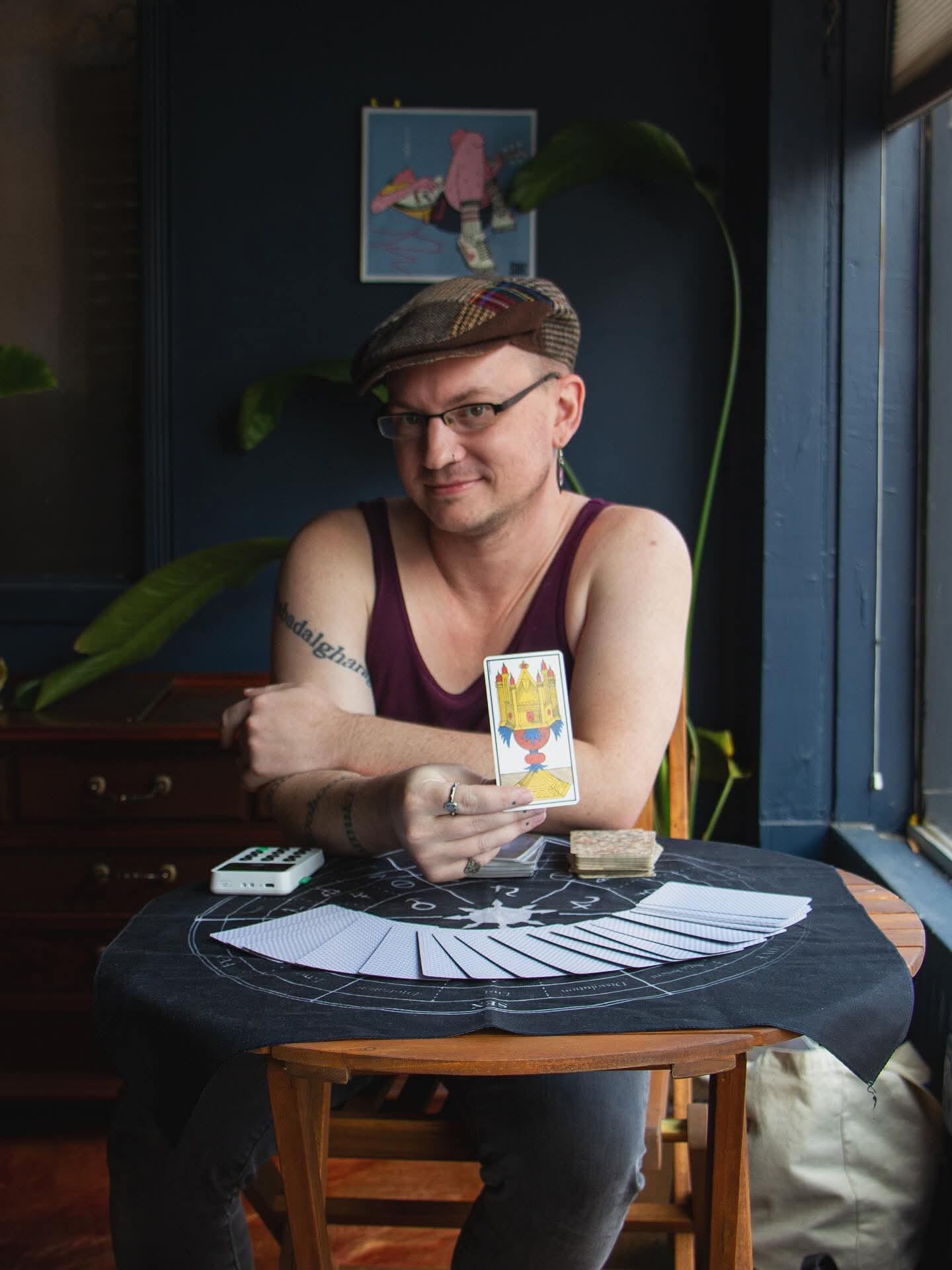
In celebration of World Tarot Day on May 25, Grimrose Manor is grateful to Jared McCoy for sharing their journey with reading tarot in the following Q&A. Jared is the owner of Cartomantic Logistics and can also be found on Instagram at @jared.of.spades. Jared offers in-person readings at various markets across the Southeast, as well as via email. Enjoy!
We’d love to hear a little about your journey to the tarot. What initially drew you to the practice and what continues making you want to share it with others?
Somehow, tarot has been in the back of my mind for most of my life. Growing up in a Southern Baptist household, I definitely didn’t have a tarot deck on hand, but I seem to remember plenty of popular media having tarot imagery or having TV characters meet a fortune teller for clues related to the episode’s plot. The most obvious example has to be Sailor Moon, which has a ton of astrological symbolism in it as well as direct tarot references in some of the title sequences.
I didn’t take a personal interest in tarot until my late 20s, since I mostly dismissed it as hippie nonsense. My interest in the larger field of divination techniques probably began with reading The Man in the High Castle by Philip K. Dick, who used the I Ching to make decisions about plot development in that novel. The idea of tarot as a storytelling device would have had more appeal to me than any mystical association to the cards.
I think the storytelling aspect is what keeps me engaged and helps me connect with other interested seekers. Whatever your worldview might be, we all have some theory or narrative that explains why things are the way they are, with varying degrees of accuracy and agency. Tarot can be a tool to examine and assess those stories, possibly toward the end of identifying more accurate or more useful ways to understand a scenario.
2. What are your go-to / preferred decks and how do you go about selecting which to use for a reading?
I currently own upwards of 25 tarot decks, as a result of a burst of beginner’s enthusiasm. I also have a handful of other kinds of divination cards like Lenormand and playing cards.
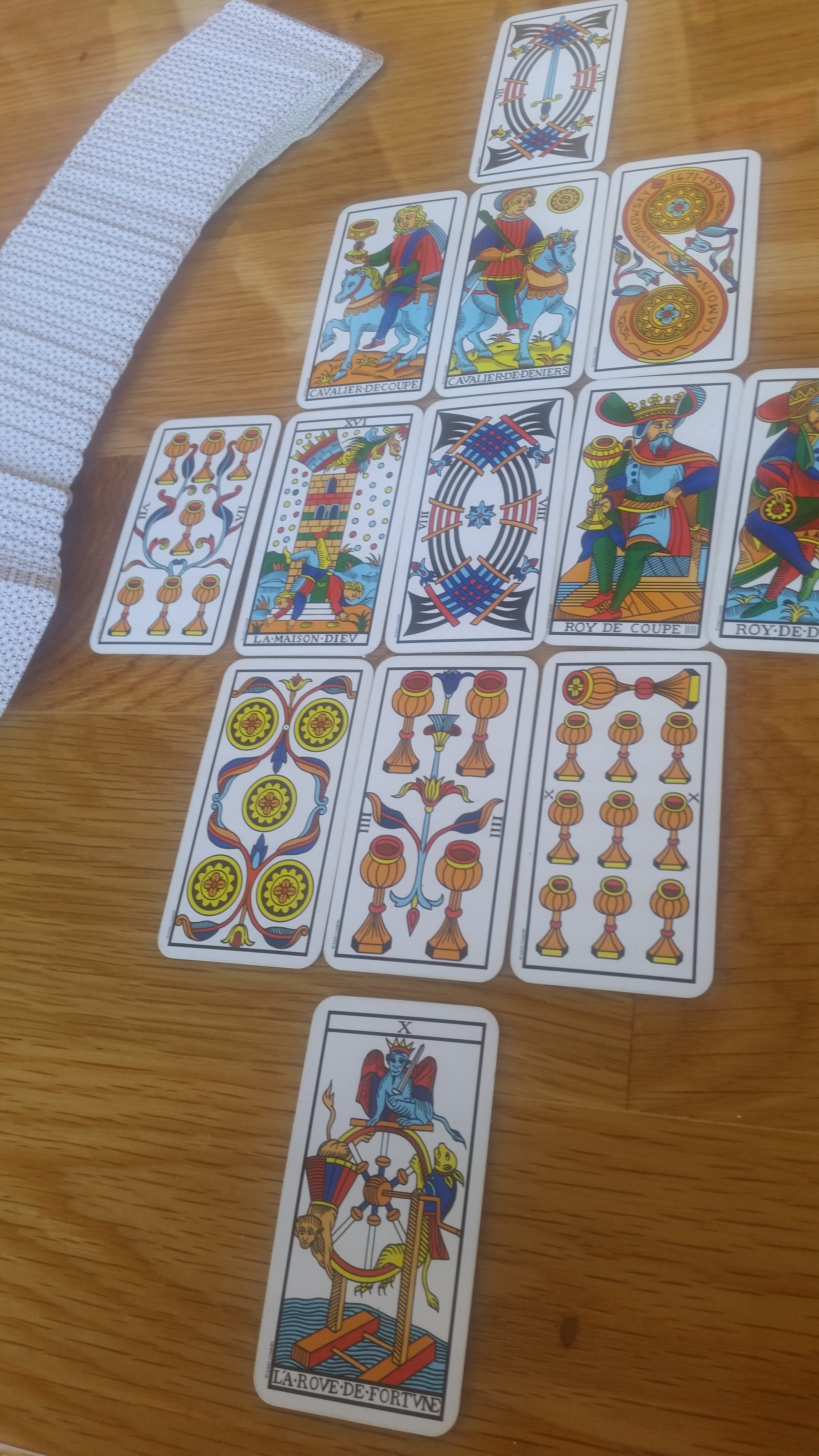
When I’m reading cards at a market setting, I typically bring a Waite-Smith deck, a Tarot de Marseille, and playing cards. Waite-Smith has all the classic imagery that people expect to see in a tarot reading, especially the “bad news” cards like Death and The Devil. The illustrated scenes in the minor cards are really easy to read in a comic strip sort of way. The court cards provide recognizable character types who navigate the Minor Arcana’s recognizable circumstances.
The Tarot de Marseille (TdM) is referred to as a pip deck, to contrast the Waite-Smith deck. The minor cards in a TdM are more like playing cards, where a card like the Eight of Cups is literally just an illustration of eight cups. When reading this kind of deck, the cards’ meanings are tied to their numerical rank, which I personally find appealing. Since the minor cards are organized into four suits, their meanings can easily be mapped onto a standard poker deck. It’s comforting for the fortune teller on the go to be able to grab a pack of Bicycle cards in an emergency.
I’m currently designing a pip-style tarot deck in linocut and stamps. It’s my first real excursion into a visual medium, and I sure picked a challenge. Designing and producing 78 cards by hand is a lot of work, but I’ll take it over plenty of the decks I see available online. One of the things I appreciate about being a tarot reader is the idea of participating in an art form with a couple centuries’ worth of tradition and development. In an increasingly digital culture, diving into more analog creative outlets feels relieving to me.
What’s it like to be a professional cartomancer? What advice might you give folks who might be interested in going this route?
The main thing about reading tarot professionally is that actually reading cards is maybe a quarter of the job at best. Finding good venues can be difficult, but the ones that stand out in that regard are incredibly valuable resources.
What’s the biggest misconception about tarot?
Unfortunately, the biggest misconception is the idea that the cards have any causative power on their own. I wish turning over the Page of Pentacles card would cause me to stumble upon treasure, but the cards just aren’t that literal most of the time. Although, weird things do still happen.
For folks who are new to the tarot, do you have any recommended reads or resources to get them started?
If you’re into podcasts, T. Susan Chang’s shows The Tarot Podcast and Fortune’s Wheelhouse are both excellent resources that include tarot history, varying perspectives in the field, and detailed studies of the individual cards and their meanings.
Books on tarot have a whole range of quality. Older texts like The Book of Thoth by Aleister Crowley and The Pictorial Key to the Tarot by A.E. Waite are great for historical context but are terrible instruction manuals. More recent books like Charlie Claire Burgess’ Radical Tarot have a more relatable tone and tips for practical application.
For general cartomancy, I highly recommend Hands of Fate by Robin Artisson. It helped me learn to read playing cards confidently and helped reshape my understanding of tarot. I found this book especially refreshing since it didn’t waste time with obscure occult symbolism and got straight to a practical method for performing divination with household items.
For further reading:


